Contact us for a complimentary energy audit

HB26-1007 opens solar to renters, condo owners, and anyone who's been priced out. Here's exactly what the law does, how the two system tiers work, and why the 395-watt option is the real game-changer.
Colorado passed HB26-1007 on April 14, 2026, legalizing plug-in solar statewide. The law creates two system tiers: a 1,920-watt system that still requires an electrician and a dedicated circuit, and a 395-watt system that you can plug into any standard outlet — no electrician, no permit, no building code compliance required.
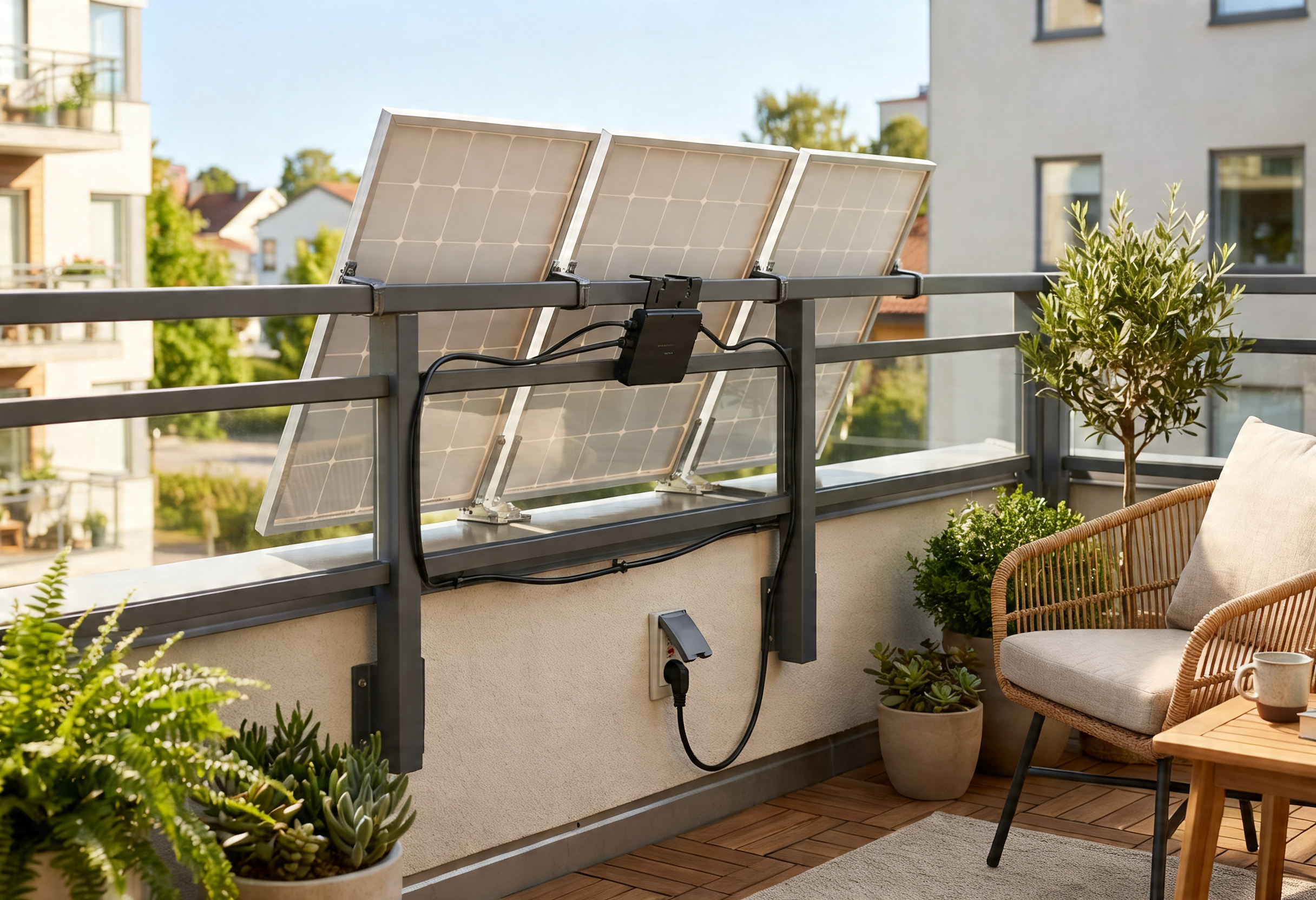
Plug-in solar is exactly what it sounds like. One to four small solar panels connect to a microinverter, and the whole setup plugs directly into a standard outdoor outlet. The panels mount on a balcony railing, sit on a patio, lean against a fence, or rest on a flat rooftop. Once plugged in, the system feeds electricity straight into your home's circuit and reduces the amount of power you pull from the grid.
These systems typically cost between $500 and $1,500 — a fraction of what a full rooftop installation runs. A plug-in system won't power your entire home, but it can shave $15 to $50 off your monthly electric bill depending on your setup and sun exposure. No roof penetrations. No permits in most cases. You unbox it, mount it, plug it in, and start saving.
Before HB26-1007, there was no legal framework for plug-in solar in Colorado. HOAs could ban panels outright. Landlords could say no. Utilities could require prior approval. The new law eliminates all three barriers for qualifying systems.
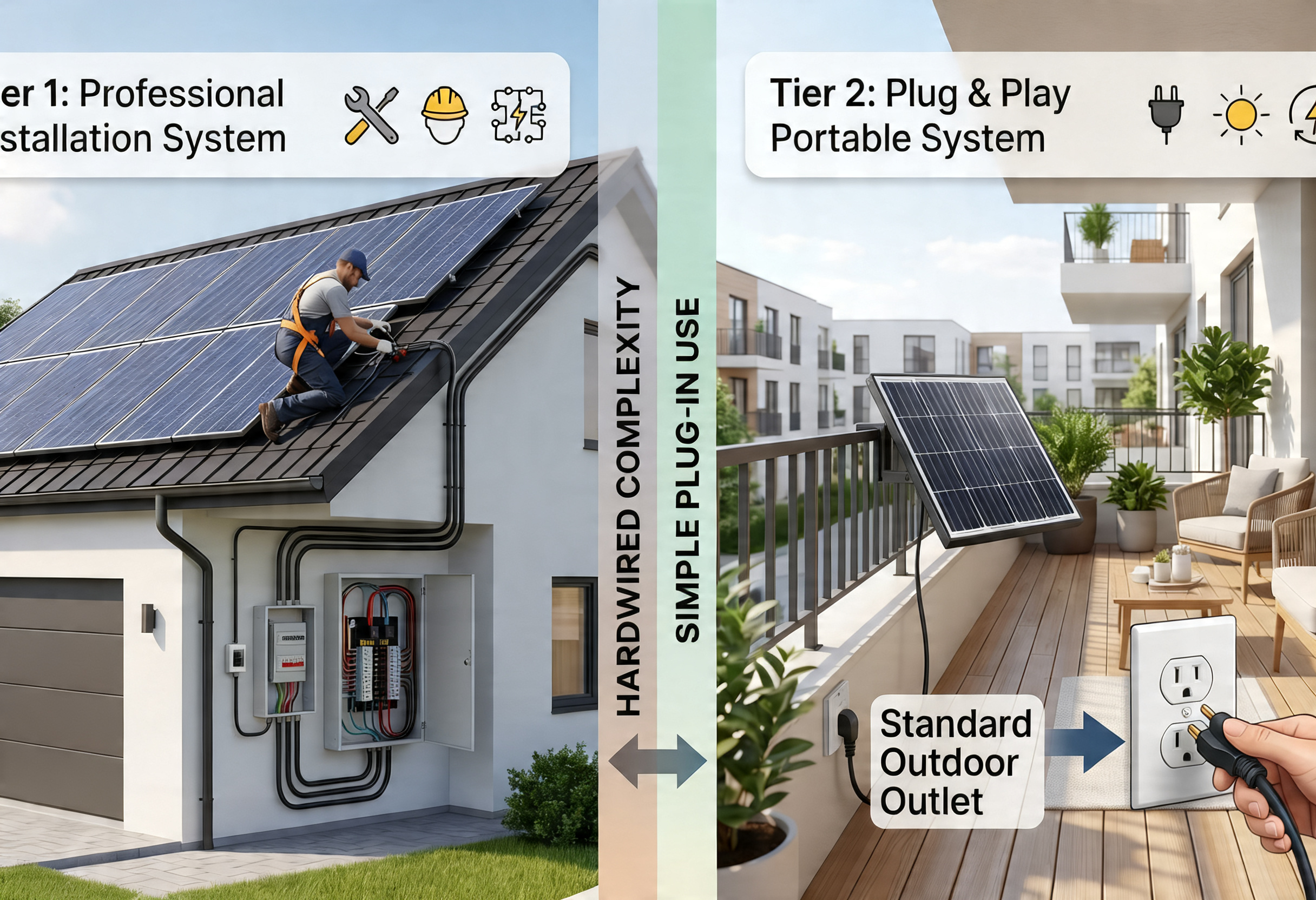
HB26-1007 doesn't treat all plug-in solar the same. The law creates two distinct tiers based on system size, and the rules for each are very different. Understanding the split is the most important thing a buyer needs to know before purchasing a system.
| Feature | Tier 1 — Up to 1,920W | Tier 2 — Up to 395W |
|---|---|---|
| Max system size | 1,920 watts | 395 watts ✓ |
| Building & electrical codes | Must comply with NEC and local codes | Exempt from building codes |
| Electrician required? | Yes — new circuit, new breaker, new wire | No — plug into any existing outlet |
| Upfront cost (total) | $500–$1,500 equipment + $500–$2,000 electrical work | $300–$800 equipment only |
| Suitable for renters? | Difficult — requires landlord consent for electrical work | Yes — portable, no modifications needed |
| UL 3700 certification required | Yes | Yes |
The National Electrical Code (NEC) has a rule that most homeowners have never heard of, but electricians know well: you cannot have multiple sources of electricity feeding the same circuit. The reason is a dangerous failure mode called breaker masking.
Here's how it works. Every circuit in your home has a breaker rated for a maximum amperage — typically 15 or 20 amps. That breaker exists to trip and cut power if the wire carrying that current gets overloaded, which prevents electrical fires. A standard 20-amp circuit has a wire designed to carry exactly 20 amps safely.
The breaker only sees the net load from the panel. It doesn't know the solar panel on Outlet 1 is adding 10A to the circuit. A 30A appliance on Outlet 2 pushes 30A through a wire rated for 20A — the wire overheats before the breaker trips.
The NEC's solution is to require plug-in solar to connect to a dedicated circuit — a single outlet on its own breaker with nothing else sharing the wire. This guarantees the breaker sees the full load. The problem: roughly 99% of homes don't have a spare dedicated circuit available for a balcony solar panel. Which means the 1,920W system isn't truly plug-and-play. An electrician has to run new wire, install a new breaker, and create a new dedicated outlet before you ever touch the solar equipment. Add that to your cost estimate.
UL published a detailed white paper on breaker masking and the safety considerations for plug-in solar systems — it's worth reading if you want the full technical picture.
There are a few other NEC-compliant workarounds for the 1,920W system beyond a dedicated circuit — but all of them require licensed electrical work. None of them let you simply buy a system at a store and plug it in. Budget accordingly.
This is the part of HB26-1007 that actually changes lives for renters and condo owners. The Colorado legislature recognized that the breaker masking risk at 395 watts falls within the safety margin already built into standard 15- and 20-amp residential circuits. At that wattage — roughly 3.3 amps on a 120V circuit — the fire risk is low enough that the state decided it was reasonable to exempt these systems from NEC compliance entirely.
What that means practically: you go to a store, buy a UL 3700-certified 395W plug-in solar kit, bring it home, mount it on your balcony railing, and plug it into any standard outdoor outlet. No electrician. No permit. No building inspector. No landlord approval needed for the electrical work. The system is classified as personal property, not a fixture, so your HOA can't ban it on your balcony.
For a Denver renter paying Xcel Energy's current residential rates, a 395W system in a south-facing apartment can realistically offset $15 to $30 per month in electricity costs. That's not whole-home solar, but it's real money back in your pocket every month — and when you move, the system moves with you.
The 395W threshold isn't arbitrary — it's engineered. The safety margin built into standard 15A and 20A residential circuits is wide enough that a 3.3A solar feed poses very limited breaker masking risk. Colorado essentially codified what the electrical engineering says: below this threshold, let people do it themselves.
Devices classified as personal property under the bill cannot be prohibited by HOAs or local governments on balconies, patios, or porches. Your board doesn't get a vote.
Xcel and other utilities cannot require customer approval before installation of a UL 3700-certified plug-in system. You don't need to call and ask permission.
All Colorado utilities must permit customer-owned meter collar adapters by December 31, 2026. These allow direct grid interconnection without costly panel upgrades.
All qualifying devices must carry UL 3700 certification, which includes automatic power cutoff, grid outage protection, and overload monitoring built in.
A common concern with plug-in solar is what happens when you unplug the system while the sun is shining. UL 3700 addresses this directly. When a qualifying device is disconnected, the prongs go dead in under one second — no shock risk. The standard also includes grid outage protection so utility workers repairing power lines are never at risk from energy feeding back from your panels. And overload protection continuously monitors the circuit to keep your home's wiring safe.
These are not experimental devices. They're tested, certified products built to a rigorous national safety standard. The 395W exemption in HB26-1007 works precisely because UL 3700-certified systems have these protections baked in.
Colorado has roughly 1.4 million renter-occupied households. Until now, nearly all of them were locked out of solar savings. Traditional rooftop solar requires owning your building, having a suitable roof, and investing thousands of dollars upfront. Plug-in solar removes every one of those barriers for the 395W tier.
Utah legalized plug-in solar in 2025. Maine followed in early 2026. About 30 other states have introduced similar legislation this year. Colorado's approach — with the explicit 395W no-code-required exemption — is one of the more renter-friendly structures in the country because it meaningfully addresses the electrician cost problem that has stalled adoption elsewhere.
Plug-in solar at 395W is a great entry point — and for renters and condo owners, it may be the best option available right now. But if you own your home and have roof space, a full residential solar installation will always deliver bigger savings and faster payback. Colorado's full retail net metering policy means every kilowatt-hour your panels produce is worth the same as the electricity you buy from Xcel — and with Xcel's rates rising nearly 10% in 2026, that value compounds every year.
Apollo Energy installs across the full spectrum. Whether you're ready for a full rooftop array with battery storage, want solar without putting panels on your roof via a solar pergola or carport, or just want to talk through what makes sense for your situation — we're here. Colorado just made it easier than ever to go solar. No matter where you live or what your budget looks like, there's an option that works.
From a 395W balcony panel to a full rooftop system with battery backup, we'll help you find the right fit for your home and situation.